Contents
What is Agriculture?
Agriculture is the practice of producing plants and cattle. [1] Agriculture is a significant factor in the rise of sedentary human civilization, as it enabled humans to live in cities by creating food surpluses from tamed species. Agriculture has a long history dating back thousands of years. Farmers began planting wild grains roughly 11,500 years ago, after harvesting them for at least 105,000 years.
Domestication of pigs, sheep, and cattle began over 10,000 years ago. Plants were grown independently in at least 11 different parts of the world. In the twentieth century, industrial agriculture based on large-scale monoculture grew to dominate agricultural output, despite the fact that about 2 billion people still relied on subsistence agriculture. Conversely, the water pollution is emerged recently that causes the agriculture system even worse.
Insight of Agriculture Issues and Future Technologies
According to the analysis, despite the fact that demand continues to rise, we will need to produce 70% more food by 2050. Meanwhile, agriculture’s contribution to global GDP has dropped to just 3%, a third of what it was decades ago. Hunger affects around 800 million individuals worldwide. In a worst-case scenario, 8% of the world’s population (650 million people) will still be malnourished by 2030. In reality, there has been very little innovation in the business in recent years—and nothing to suggest that food scarcity and famine will not be a problem in the next decades.
To overcome these problems, governments, investors, and agricultural technology innovators will need to work together. Water, fertilizers, and pesticides will no longer be applied consistently over entire fields in Agriculture 4.0. Farmers will instead utilize the bare minimum of quantity and focus on very specific places. According to the paper, farms and agricultural operations would have to be operated considerably differently in the future, owing to technological improvements such as sensors, devices, equipment, and information technology. Robots, temperature and moisture sensors, aerial photographs, and GPS technology will all be used in the future of agriculture. Farms will be more profitable, efficient, safe, and environmentally friendly as a result of these modern equipment, precision agriculture, and robotic systems.
Governments can play an important role in resolving the issue of food scarcity. They need to take on a bigger and more visible role than just regulating and facilitating things.
Governments can achieve the following goals by disrupting the traditional legacy model and pursuing such a program:
- Ensure food security and reduce import dependency
- Develop into a net exporter of not only items, but also intellectual property and new ideas.
- Boost productivity and encourage the transformation to a knowledge- and innovation-based economy.

1. Hydroponics
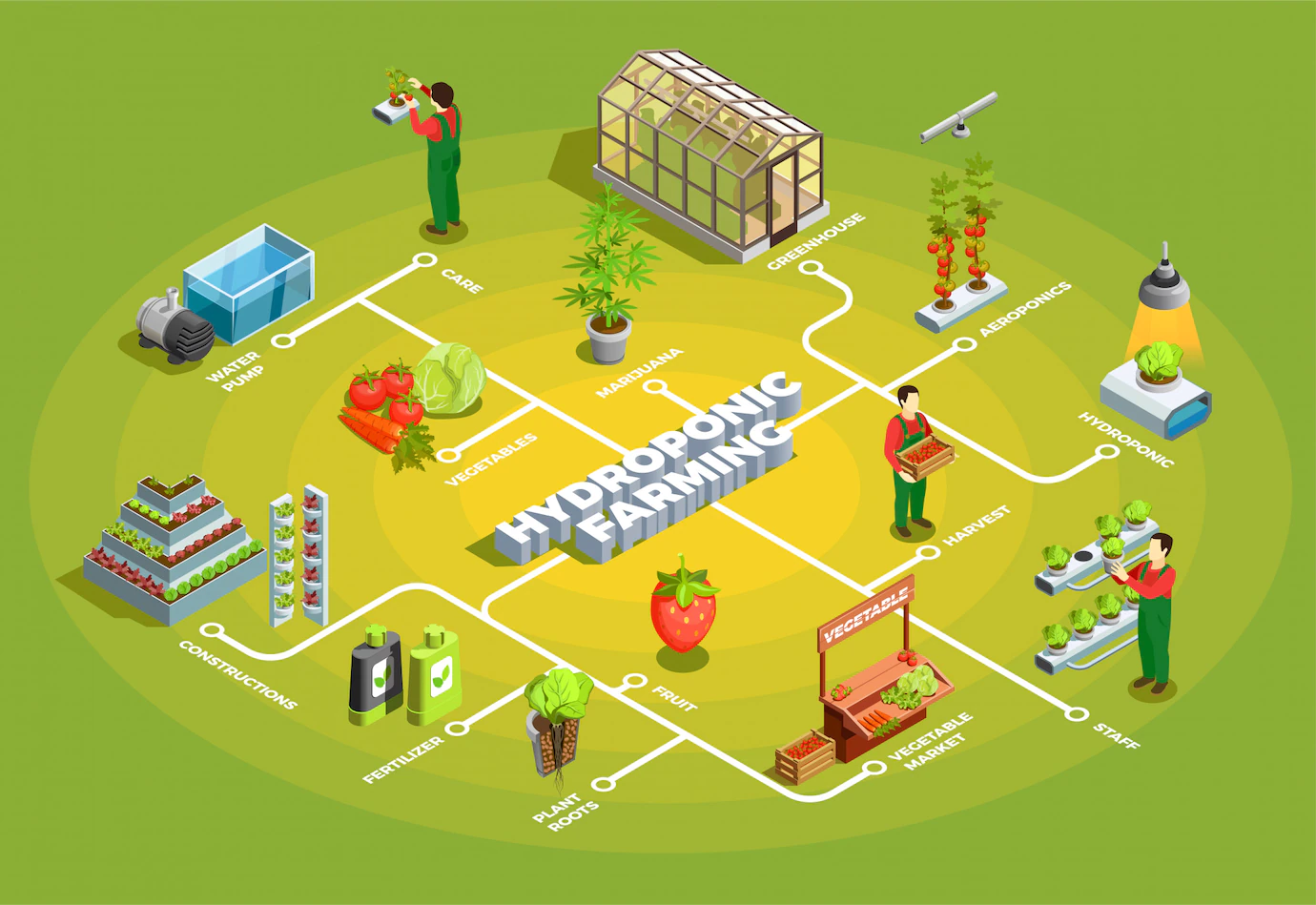
The method of growing plants without soil using mineral fertilizer solutions in a water solvent is known as hydroponics, which is a subset of hydroculture.
Sundrop, an Australian firm, has invented a seawater hydroponics technology that combines sun, desalination, and agricultural to grow vegetables in any climate. This system is environmentally friendly, as it does not use fossil fuels and instead draws its energy from the sun. It also does not require land. Solar power, electricity generation, freshwater production, and hydroponics are all integrated into its technologies. As a result, the amount of food produced is comparable to that produced using traditional methods. Sundrop can create a seawater greenhouse—a combination of sun, desalination, and agriculture—to grow veggies anywhere on the planet using hydroponics.
2. Vertical Farming
Over four million metric tons of fruits and vegetables were imported into the UAE in 2016. Both the UAE government and its residents will profit from facilitating the creation of a cost-effective, commercial-scale agribusiness that offers fresh produce to local communities.
Vertical farming is one solution for supplying high-quality vegetables in a sustainable manner. Vertical farming is the practice of producing food in difficult circumstances where sufficient land is lacking by growing food in vertically stacked layers. It uses soil, hydroponic, or aeroponic growth methods and is associated with urban farming. While increasing yield, the procedure utilizes 95 percent less water, less fertilizer and nutritional supplements, and no pesticides.
AeroFarms, situated in the United States, has been developing, owning, and running indoor vertical farms that produce safe and nutritious food since 2004. It is at the forefront of high-tech, data-driven, commercial-scale vertical farming around the world. Its farms can grow produce all year, allowing them to achieve potential yields that are 390 times higher than a regular farm of the same size. Extreme weather events and seasonal changes have no effect on production. Fruits and vegetables stay fresher for longer since they are cultivated locally rather than imported.
Similarly, Plenty’s field-scale indoor farms in San Francisco integrate agriculture and crop science with machine learning, IoT, big data, and climate-control technologies to grow healthy food while using the least amount of water and energy possible. SoftBank Vision Fund and Amazon CEO Jeff Bezos have invested in Plenty, which will help the company improve its farms.
Governments have also taken steps to promote this technology. In the Netherlands, these growing techniques have sparked an indoor growing boom: greenhouses currently produce 35 percent of the country’s veggies despite occupying less than 1% of the country’s cropland.
3. Genetic Technology
Drought-resistant wheat was developed using traditional breeding procedures, and it was this crop that led the first wave of higher yields in the developing world. However, genetic engineering will be required to meet future food needs.
CRISPR (clustered, regularly interspaced, short palindromic repeat) technology is a revolutionary new way to genome editing that allows for greater selection and lowers the probability of error. The approach can be used to propagate crops with necessary vitamins, nutrients, and minerals, as well as generate breeds with enhanced yields and resilience to harsh environments. CRISPR is assisting in the development of genetically modified animal foods.
Drought-resistant wheat was developed using traditional breeding procedures, and it was this crop that led the first wave of higher yields in the developing world. However, genetic engineering will be required to meet future food needs.
CRISPR (clustered, regularly interspaced, short palindromic repeat) technology is a revolutionary new way to genome editing that allows for greater selection and lowers the probability of error. The approach can be used to propagate crops with necessary vitamins, nutrients, and minerals, as well as generate breeds with enhanced yields and resilience to harsh environments. CRISPR is assisting in the development of genetically modified animal foods.
How Japanese Farmers Response Future Agriculture Challenges
Smart farm technology holds great promise for farmers struggling to grow Japan’s staple grain while wrestling with low prices. Among the benefits: lower production costs, higher income and a workaround for the country’s chronic manpower shortage.
The new technologies, including drones that can spray crops with fertilizer and pesticides, and rice transplanting machines equipped with GPS, also have the potential to lower supermarket prices. This will help farm businesses by helping to shore up Japan’s dwindling rice consumption and by making exports more competitive.
Tanaka Nojo, a rice farming corporation in Japan’s western Tottori Prefecture, plans to introduce smart farming this growing season. It has purchased chemical-spraying drones and a GPS-ready rice transplanter, which injects seedlings into paddy fields.
Including fruit orchards and vegetable fields, the farm has 120 hectares of planted area, 100 times the national average of 1.2 hectares. The company expanded its operation by leasing adjacent farmland, but its growth slowed as the farm became too big for the available workforce.
With the new technology, “we will be able to reduce working hours by about an hour per day and it will help us expand further,” said the company’s president, Satoshi Tanaka. “We will be able to cut production costs by up to 10%.”
Fukuhara Farm, in central Japan’s Shiga Prefecture, introduced an automated rice transplanter last spring, aiming to reduce labor costs and increase production of the low-priced rice varieties that many restaurant operators prefer.
“It’s only a matter of time before the price for 60 kg of rice falls below 10,000 yen ($93),” said Fukuhara Farm Chairman Shoichi Fukuhara. “Our aim is to maintain an operation that can earn sufficient profit even after prices drop.”
According to Japan’s agriculture ministry, the average production cost nationwide for rice-growing households and corporations stood at 15,352 yen per 60-kg bag in 2018, down 20% from 30 years earlier. But production costs have stopped falling over the past five years or so.
“Although the [cost] reduction progressed, thanks to expanded [farm] scale, that seems to have reached its limit recently as it has become difficult to find people due to the labor shortage,” said an official with the ministry’s grain division.
Rice prices, meanwhile, have been on a long-term slide, squeezing farm income. And production costs have been creeping higher since the 2014 season, with consumers increasingly preferring premium brands that are more expensive to grow. “As brand awareness has grown in production areas, allowing [rice] to be sold for higher prices, moves to lower costs have lost steam,” said Yasufumi Miwa, a scholar at the Japan Research Institute.
Smart farming may help, but so far high-tech has had biggest impact in vegetable cultivation; progress has been slower with rice growing. “There have been almost no examples of [farmers] introducing the [smart farming] equipment, such as the sale of machines and use of related services, which have [only] begun in the past year or two,” according to an official at the agriculture ministry’s research promotion division.
In fiscal 2019, the ministry launched the first smart farming demonstration project for rice cultivation. By renting equipment to agricultural cooperatives and others across the country, the ministry will study the effectiveness of the new techniques in lowering costs. It estimates that smart farming could cut the man-hours required for rice cultivation in half while boosting yields by 10% to 20%.
The price of the sophisticated equipment, which is between 10% and 50% higher than that of conventional farm implements, is a hurdle. But as more farmers introduce high-tech machinery, the techniques may take hold.
Japan’s rice growers need to make their product more price-competitive. Domestic prices are still far higher than those on the world market. They face a further challenge: The food service industry is buying more cheap imported rice and turning away from pricier domestic products. And although exports hit an record annual record in 2019, sales “are limited to a few affluent people,” said an official at a major rice wholesaler.
Back to the agricultural point, here is the reason why the Japanese still number 1 in the game:
1. Genetic Engineering of Rice Nurseries

Japan has high-quality food products that have not escaped their development in the field of research, especially in working on genetic engineering. Although stages like this have begun to develop in other countries, Japan is the only country that has successfully maximized this genetic engineering.
2. Use of a Rice Growing Machine

Most of the work carried out by the Japanese community is inseparable from the use of sophisticated equipment, including in agriculture. Japan has a modern rice planting machine that has the name Rice Transplanter with this device that can facilitate farmers in placing rice, in addition to being easier, the tool used can deliver precise results. India has started to develop a similar engine, but not a few farmers have used this technology.
At present, almost all types of rice planting machines in Japan have realized the technology of self-propulsion Type, which can be operated by being driven or driven depending on the distance of the planting groove.
3. Handling

Most farmers in many countries in working on treatments such as spraying pesticides and fertilizer application are carried out by manual techniques and require a long time. All Japanese farmers showed the opposite. In this country, the provision of fertilizers and other treatments is only carried out by one person with the help of a tractor designed in such away. With this machine, they only need shorter periods and are easier to maintain.
4. Rice Harvesters

Rice harvesters have the name Indo Combine Harvester that already exists in India, and this device requires at least three people to operate it in the process of harvesting. Technology from Japanese agriculture has agricultural tools that only need one operator to manage it. By using this tool, the activity is certainly more maximal.
5. Cloud Computing for Agriculture

It turns out that besides using sophisticated equipment, agriculture in Japan also has them computerized on their farms. One of them is using Cloud Computing. This system, made by Fujitsu, and has been used by various agricultural agencies used in Japan such as Aeon Agri, Shinpuku Seika, Sowakajeun and Fukuhara.
Cloud Computing is those that are created to detect rain predictions of environmental humidity levels with the technique of placing as many sensors at the location of the plant. The data received by the sensor is synchronized in one of them and can be noticed via a smartphone or tablet PC. With this technology, it is desirable to be able to reduce the occurrence of not succeeding in harvesting the impact of unexpected Japanese weather conditions, besides that it is also beneficial to be able to increase the quality of the crop.
6. Indoor Agriculture

Japan, especially the City of Tokyo, is the largest metropolitan city in the world that has not a few skyscrapers. But who would have thought if in Tokyo the city had agricultural land that had a reasonably large area? The farm area is inside the building.
Pasona 2 is a rice field area developed and managed by Pasona Group. The uniqueness of the location of this rice field is its location, which is in the basement of its 27-story building in the Business District area. At a location of 3,000 m2, it uses technology that can grow rice without sunlight.
In place of sunlight, using modern technology to control rice plants can grow well, such as the use of lights and temperature controllers that are arranged in a computerized manner. Besides rice, Pasona 2 has at least 100 other types of plants such as fruits, vegetables, flowers, and various spices.
Lowering retail prices is crucial if Japan is to halt the decline in rice consumption and spur export demand. Rice-growing areas have trimmed the amount of land under cultivation as consumption has fallen. The government tried for nearly half a century to shore up prices by nudging farmers to take land out of production.
But the gentan policy was scrapped after the 2017 season as consumers continued to shun the traditional staple and the program fell short of its goals. Smart agriculture has the potential to succeed where previous government policy has failed, halting and perhaps reversing the downward spiral in rice consumption and production in Japan.