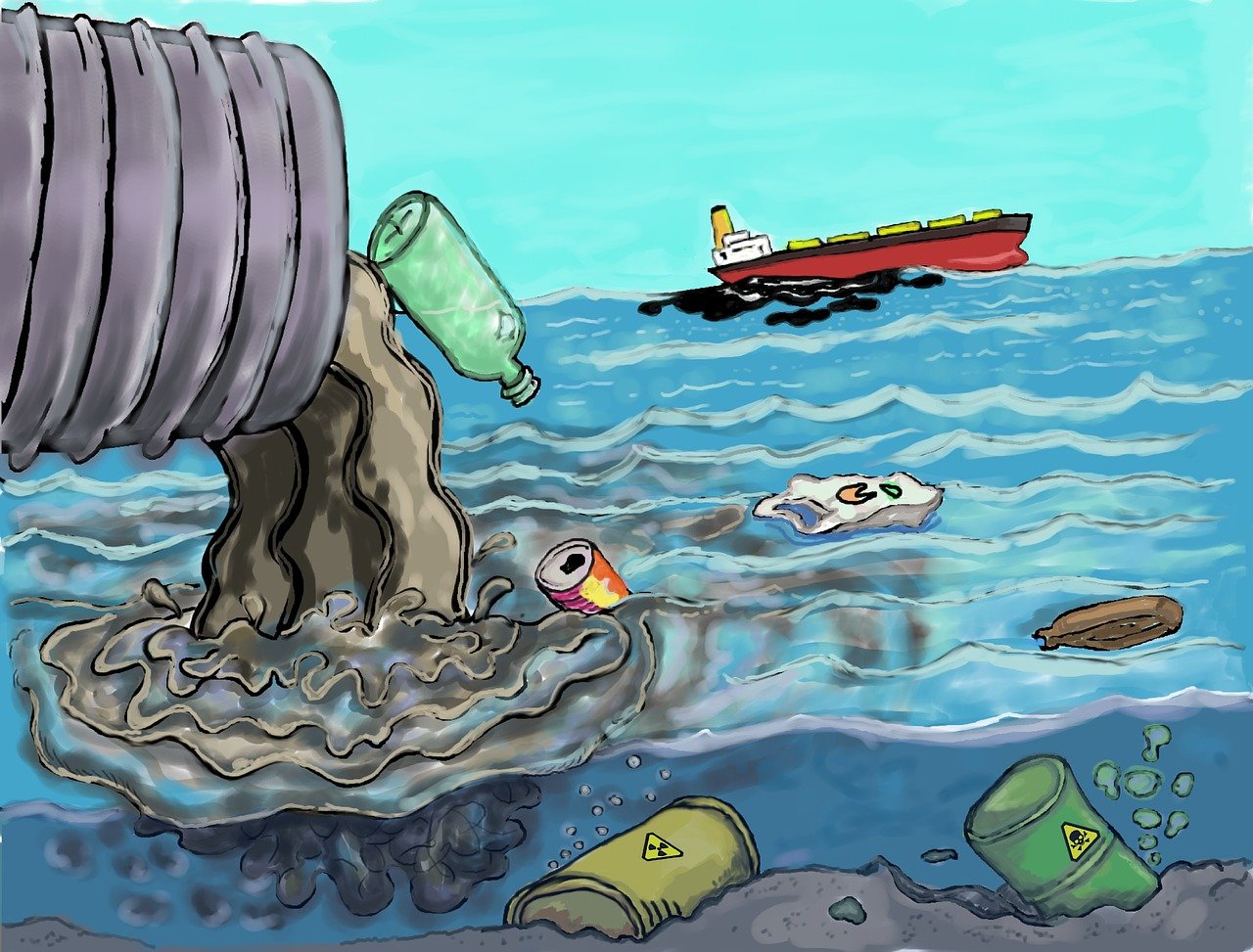
Water pollution causes toxic compounds to enter water bodies such as lakes, rivers, and seas, where they are dissolved, suspended in the water, or deposited on the bed, resulting in water pollution. Water quality suffers as a result of this. Water pollution is defined as the discharge of pollutants into underground groundwater or lakes, streams, rivers, estuaries, and seas to the point when the contaminants obstruct beneficial water usage or ecosystem function. Water pollution can involve the discharge of energy, such as radiation or heat, into bodies of water in addition to the release of things such as chemicals or bacteria.

Not only would this be disastrous for aquatic ecosystems, but the contaminants will also seep through and reach groundwater, potentially contaminating the water we use in our everyday activities, including drinking.
Water pollution may occur in a variety of ways, with municipal sewage and industrial waste discharge being one of the most harmful. Contaminants that reach the water supply through soils or groundwater systems, as well as rain, are examples of indirect causes of water contamination.
Human farming activities, as well as poorly disposed of industrial pollutants, are found in soils and groundwaters.
Our health is being jeopardized by the pervasive problem of water contamination. Each year, unsafe water kills more people than all other types of violence combined. Meanwhile, our supplies of potable water are limited: We have access to less than 1% of the world’s fresh water supply. If nothing is done, the problems will only become worse by 2050, when global freshwater demand is estimated to be one-third more than it is currently.
Water is very susceptible to contamination. It sometimes known as a “universal solvent,” can dissolve more chemicals than any other liquid on the planet. We have Kool-Aid and vivid blue waterfalls because of it. It’s also the reason why water is so readily contaminated. Toxic compounds from farms, cities, and factories easily dissolve and combine with it, polluting the water.
Contents
1. Domestic sewage the water pollution pathogens
The first water pollution is pathogens (disease-causing bacteria) and putrescible organic compounds that are mostly found in domestic sewage. Due to the fact that infections are discharged with feces, all sewage from cities and towns is likely to include pathogens of some sort, posing a direct threat to public health. Putrescible organic debris, on the other hand, poses a unique hazard to water quality. The dissolved oxygen level of the water is lowered when organics degrade naturally in the sewage by bacteria and other microbes. To kill such pathogens, we can use water treatment technologies for large scales or water filter at small scale such as at home.
This jeopardizes the health of lakes and streams, where fish and other aquatic species rely on high oxygen levels to thrive. Pathogens and organics in wastewater are reduced by sewage treatment methods, although they are not totally eliminated (see also wastewater treatment).
2. Toxic waste

Toxic waste is also part of water pollution. It is poisonous, radioactive, explosive, carcinogenic (causes cancer), mutagenic (causes chromosome damage), teratogenic (causes birth defects), or bioaccumulative (causes birth problems) (that is, increasing in concentration at the higher ends of food chains). Toxic chemicals come from a variety of places, including inadequately discarded wastewater from industrial plants and chemical processing facilities (lead, mercury, chromium), as well as surface runoff including pesticides used on agricultural fields and residential lawns (chlordane, dieldrin, heptachlor). (See poison and hazardous waste for a more in-depth look at harmful substances.)
3. Sediment
Surface runoff can carry sediment (e.g., silt) into water bodies as a result of soil erosion. Suspended silt obstructs sunlight penetration and disrupts a body of water’s natural equilibrium. It can also disturb fish and other forms of life’s reproductive cycles, and when it falls out of suspension, it can suffocate bottom-dwelling creatures.

In the United States, sediment contamination is the most prevalent cause of water pollution. Natural erosion accounts for around 30% of the total, while human activity accounts for the remaining 70%. The most prevalent cause of sediment contamination is construction. Sediment contamination costs the ecosystem around $16 billion each year, according to the Environmental Protection Agency.
How sediment causes water pollution?
Sediment contamination in streams can have long-term consequences for aquatic insects, fish, and other animals. It obstructs animals’ ability to perceive food sources by clouding the water. Suspended particles impede light and inhibit aquatic plant development. It settles on the streambed, reducing habitat for critical aquatic insects, which are an essential food source for trout. Sediment can suffocate bug larvae and fish eggs, as well as obliterate fish breeding grounds. It can even block fish gills or kill them in extreme situations.
Sediment may flood streams, lakes, and ponds, restrict waterways, and jam storm sewers and ditches, in addition to its impacts on aquatic flora and animals. Sediment deposits in rivers can change water flow and lower water depth, making navigation and recreational activities more challenging.
4. Thermal pollution
Heat is a contaminant in water pollution because it reduces the capacity of water to contain dissolved oxygen in solution and raises the rate of metabolism in fish. Important game fish species, such as trout, cannot live in water with very low dissolved oxygen levels. The practice of releasing cooling water from power stations into rivers is a major source of heat; the released water may be up to 15 degrees Celsius (27 degrees Fahrenheit) warmer than naturally occurring water.

[SD]
How thermal water pollution as unseen water pollution
Organisms and ecosystems may thrive in a variety of environments. When compared to the temperature extremes on other planets for which we have data, the temperature range on Earth is fairly tiny. Even the most adaptable earth-bound organisms have limited temperature tolerances. The temperature range is thus one of the most important aspects in public health and environmental situations.
Heat balances in the environment can be altered by anthropogenic, or human-caused, activities. Heat, like other important life-sustaining components, may become a pollutant if circumstances demand it. There is an ideal temperature range, just as there is an optimal amount of oxygen or water for an organism or environment. This range varies depending on the species. As a result, releasing heat into an ecosystem might alter the habitat of one or more species, causing the temperature to fall outside of the optimum or survival ranges.
The increased heat may also have an indirect impact on the ecosystem by changing other variables that damage species, including people, such as dissolved oxygen levels in surface waters. This type of input can happen at any size in the environment as water pollution. A small-scale modification to a section of an aquatic system, for example, interferes with microbial metabolism at the cellular level. Large-scale changes in global heat balances raise seasonal ambient temperatures on a global scale, which can exacerbate or cause human health and environmental concerns.
Higher ambient temperatures, for example, are linked to an increase in heat stress, and these same temperature increases, as well as other indirect climatic changes, can have negative consequences for ecosystems and human populations. According to recent research, if climate change causes more regular episodes of temperature rises on a local scale, such as the heat island effect in many cities, this would likely contribute to an increase in the frequency of cardiovascular and respiratory ailments, as well as related mortality [2, 3]. According to studies, the impacts will not be uniformly dispersed.
In reality, local cooling extremes are expected in some areas, which might have an impact on human health and environmental circumstances. The poorest groups are expected to suffer as a result of the changes [4].
As previously stated, alterations of water pollution in the heat budget can have an indirect negative impact on the ecosystem. Adding heat to an ecosystem, for example, can have an impact on sensitive species ranging from microbes to plants to animals, through sea-level rise, increased intensity of extreme weather events, and changing micrometeorological patterns, as well as habitat loss and changing natural cycles, such as nutrient cycle changes that alter the rates and size of algal blooms and disease outbreaks [5].
These changes have the greatest impact on the most vulnerable species initially, but the consequences are amplified due to the food-prey connections. If a substitute is not available, the loss or reduction of a food species hurts the next trophic level, and even if a substitute is available, it may affect other species that rely on it as their primary or sole food supply. As a result, even little variations in temperature can cause significant changes in biological structure and trophic status [6, 7].
Thermal water pollution have an impact on the environment in all phases and media. If the addition of heat directly or indirectly impacts the biota residing in surface wards, it may be considered a water pollution. Raised water temperatures, for example, can affect an ecosystem’s biodiversity in two ways. The higher temperature may be too hot for aquatic biota to tolerate, and/or the increased temperature promotes microbial growth, which reduces dissolved oxygen, makes metals more accessible, and/or raises the risk of nutrient and toxin poisoning in various ways.
5. Petroleum (oil) pollution
Another water pollution is when oil from highways and parking lots is transferred into aquatic bodies by surface runoff, it is known as petroleum (oil) contamination. Accidental oil spills, such as those caused by the vessel Exxon Valdez (which spewed more than 260,000 barrels in Alaska’s Prince William Sound in 1989) and the Deepwater Horizon oil rig, are also a source of pollution (which released more than 4 million barrels of oil into the Gulf of Mexico in 2010). Oil slicks ultimately make their way to the coast, endangering marine life and causing damage to recreational areas.
https://www.britannica.com/science/water-pollution
Water pollution is defined as the discharge of pollutants into underground groundwater or lakes, streams, rivers, estuaries, and seas to the point when the contaminants obstruct beneficial water usage or ecosystem function. Water pollution can involve the discharge of energy, such as radiation or heat, into bodies of water in addition to the release of things such as chemicals or bacteria.
Pathogenic bacteria, putrescible organic waste, plant nutrients, poisonous compounds, sediments, heat, petroleum (oil), and radioactive substances are all examples of pollutants that may pollute water bodies. Several forms of water contaminants are discussed in the following sections. (See waste disposal for further information on how sewage and other kinds of waste created by human activities are handled.)
6. Plastic Pollution
Plastic pollution is the buildup of synthetic plastic items in the environment to the point that they pose a threat to animals and their habitats, as well as human populations. Bakelite’s development in 1907 ushered in a material revolution by introducing genuinely synthetic plastic resins into global commerce. Plastics, on the other hand, have been discovered to be chronic pollutants of various environmental niches by the end of the twentieth century, from Mount Everest to the ocean’s depths. Plastics have gained growing attention as a large-scale problem, whether they are mistaken for food by animals, flood low-lying regions by blocking drainage systems, or just cause substantial visual blight.
How plastic causes water pollution?
Plastic is a polymeric substance, which means it has very massive molecules that resemble lengthy chains made up of an apparently endless succession of interconnecting connections. Natural polymers like rubber and silk are abundant, but because they do not remain in the environment, nature’s “plastics” have not been linked to pollution. Today, however, the ordinary consumer is exposed to a variety of plastic materials that were designed particularly to combat natural decay processes—materials derived mostly from petroleum that may be molded, cast, spun, or coated as a coating.
Synthetic plastics tend to remain in natural environments because they are mostly nonbiodegradable. Furthermore, many lightweight single-use plastic goods and packaging materials, which account for almost half of all plastics manufactured, are not placed in containers for later disposal in landfills, recycling centers, or incinerators. Instead, they are inappropriately disposed of at or around the point where their utility to the customer has expired. They harm the environment as soon as they are dropped on the ground, flung out of a car window, heaped into an already full trash bin, or mistakenly swept away by a gust of wind.
In many areas of the globe, landscapes strewn with plastic packaging have become the norm. (Illegal plastic dumping and overflowing containment structures are other factors.) Despite the fact that population centers create the most trash, studies from throughout the world have found no single country or demographic group to be the most guilty. Plastic pollution has both global and local origins and impacts.