
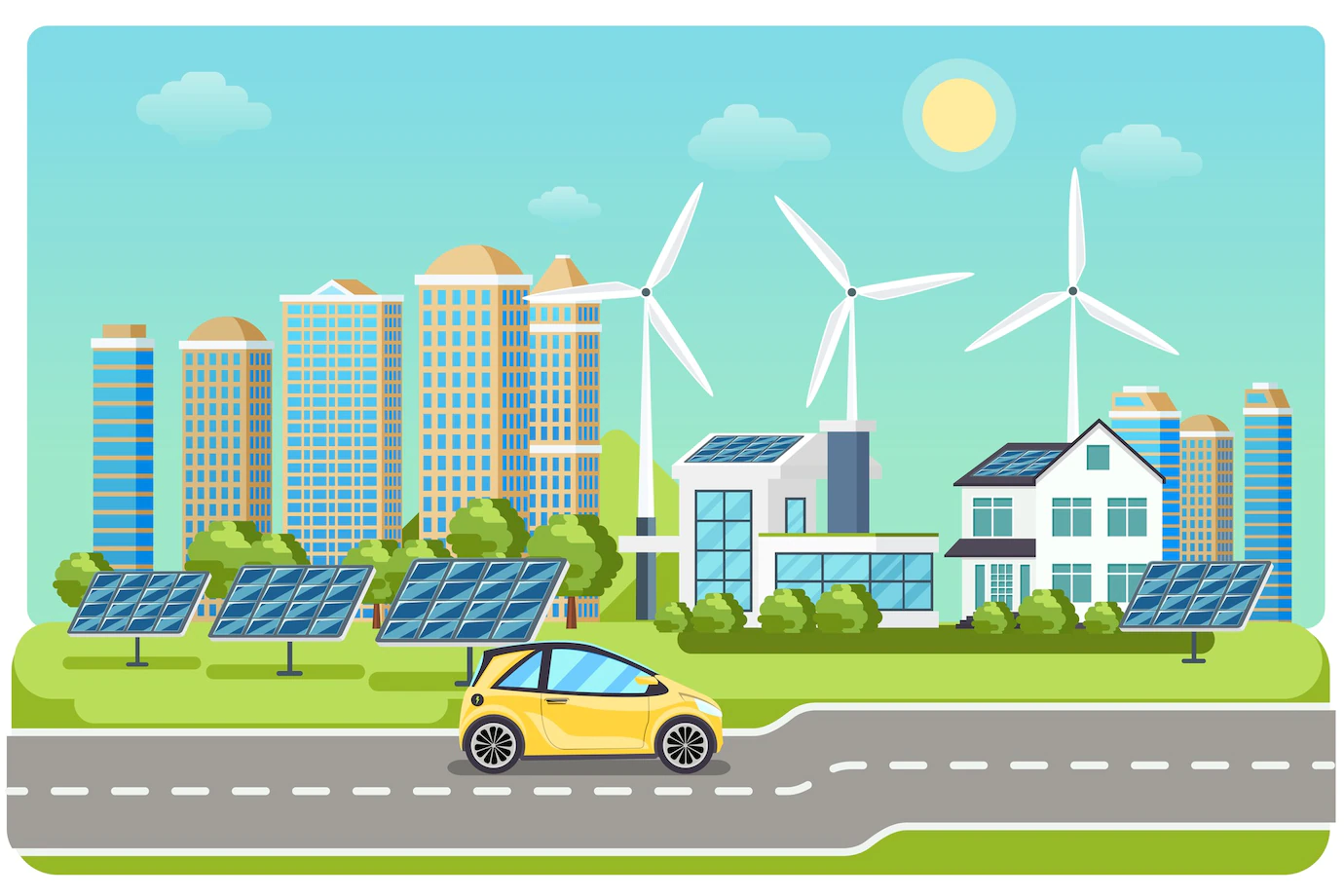
Renewable energy is created from naturally replenishing and endless sources, such as the sun and wind. Transportation, space and water heating and cooling, and electricity generation are all possible with renewable energy.
Contrarily, non-renewable energy is derived from limited resources that may run out, such as fossil fuels like coal and oil.
Contents
Introduction
Sources: https://www2.deloitte.com/us/en/insights/industry/power-and-utilities/us-renewable-energy-transition.html
The proportion of renewable energy in US electricity output has increased by half in just 10 years, from 10% in 2010 to 20% in 2020. 1 Solar and wind energy have seen the vast bulk of that growth, with rates of compound annual growth over the past ten years of 84 percent and 15 percent, respectively. 2 Despite these remarkable developments, the pace will need to pick up considerably if the United States is to meet its clean energy targets.
The nation has more than 100 gigawatts (GW) of solar power capacity3 and 122.5 GW of wind power capacity4 at the end of 2020, but to decarbonize the power industry between 2035 and 2050, up to 70-100 GW each of solar and wind will need to be added annually. 5
The US administration supports a target of emission-free electricity by 2035, whereas the majority of nations aim for net-zero emissions by 2050. 6 How challenging will it be to travel there? Managing supply chain restrictions, integrating variable renewables, addressing catastrophe vulnerability, meeting future electricity demand, and satisfying demand for renewable electricity are five of the most frequently mentioned difficulties, which are explored in this research. We also look at various industry viewpoints, statistics, and data, as well as commonly held beliefs about the problems and what’s needed to fix them.
Cost comparison between conventional and non-conventional energy sources
Common misconception: Government incentives, such as tax credits, are the only reason solar and wind energy are competitive with traditional power facilities.
Reality and industry perspectives: Even without tax incentives and when integration costs are taken into account, solar and wind power are now the most affordable electricity production options throughout the majority of the United States and the rest of the world. Even with battery storage, these resources are frequently competitive. And prices keep dropping.
In the last ten years, utility-scale solar photovoltaics (PV) costs in the United States and around the world have dropped by 85% and around 55%, respectively, for onshore wind and solar energy generation, respectively.
7 Figure 1 compares the levelized cost of energy, or the amount of money needed to establish and operate a generation source over a 30-year period, for various types of generation technology (LCOE). The LCOE ranges show that wind and solar energy still have competitive costs even in the absence of tax credits.
Due to the fact that wind and solar are variable renewable energy (VRE) resources, continuing investment is necessary to ensure their seamless integration into the grid. This includes new transmission, energy storage, and more digitalization8 for flexibility. Even yet, the industry expects that integration costs will be $5 per megawatt hour (MWh), which makes wind and solar energy’s LCOEs competitive with those of gas and coal-fired power plants. 9
In order to increase dispatchability, plants are increasingly being designed with battery storage due to the unpredictability of wind and solar energy. In the whole United States, the average LCOE for solar-plus-storage “hybrid” facilities is not yet competitive with combined cycle gas turbines (CCGT) (figure 1). However, market pressures in some areas with a high renewable market penetration, like California, make hybrid plants more cost-effective than CCGT. This trend is anticipated to expand to other states as the market penetration of renewable sources rises. 10
Prices for power purchase agreements (PPAs) for wind and solar energy are competitive with those for other sources. For the first half of 2021, the weighted average US price for solar PV generated through auction and PPAs is US$31/MWh, compared to US$37/MWh for onshore wind. 11 This contrasts with a weighted average wholesale electricity price across US markets over the same time of about US$34/MWh. 12
In many instances, it is less expensive to construct new solar and wind power facilities than to keep operating coal-fired ones. In fact, it is predicted that the operational costs of new solar or wind generating generation will be higher in 2021 in between 77 and 91 percent of the US’s coal-fired capacity. 13 Additionally, similar pattern might increasingly apply to nuclear and gas-fired power facilities. Figure 2 contrasts the marginal costs of current conventional generation with the levelized costs of energy from newly constructed wind and solar plants.
Advantages Renewable Energy
Numerous benefits of renewable energy exist and have an impact on the national economy, the environment, national security, and public health. The following are some advantages of adopting renewable energy in the US:
- Enhanced national power grid resilience, security, and reliability
- generation of jobs across all sectors utilizing renewable energy
- reduced air pollution and carbon emissions from energy generation
- greater American energy independence
- more affordable since various forms of renewable energy can compete in price with conventional energy sources
- increased access to renewable energy for distant, coastal, or island communities without grid connections.
- Find out more about the benefits of renewable energy sources such as wind, solar, bioenergy, geothermal, hydropower, and marine energy as well as how DOE is attempting to upgrade the grid.
About 20% of the electricity in the United States is produced using renewable energy, and this figure is rising. The percentages of each source of renewable energy that will make up the total amount of electricity produced in 2021 are shown in the graph below:


The U.S. electricity system is anticipated to add more than 60% of the utility-scale generating capacity from solar and wind in 2022. (46 percent from solar, 17 percent from wind).
The United States has a lot of renewable energy resources and is a resource-rich nation. The amount available is 100 times more than what the country needs in electricity each year. Learn more about the potential for renewable energy in the US.
Renewable Energy Records
Between 2011 and 2020, the amount of electricity generated by solar and wind in the United States approximately doubled. Over that time, the three technologies increased annually by around 15%, while geothermal generation remained largely unchanged.
These conclusions are based on a study that was released on Tuesday by the nonpartisan research group Frontier Group and the nonprofit Environment America Research and Policy Center. The analysis also revealed that by 2035, when President Biden wants to have a grid fully devoid of fossil fuels, wind, solar, and geothermal energy would be able to fulfil current electricity demand levels.
According to Emma Searson, one of the report’s authors, “the rate of change is continuing to pick up.” “Exactly what we need to see in the upcoming years”
Using statistics from the U.S. Energy Information Administration, Searson and her coworkers estimated that the country will produce 470,141 gigawatt-hours of electricity from wind and solar sources by 2020, up from 125,820 gigawatt-hours in 2011. As of 2020, geothermal generation was at a relatively modest 16,930 GWh, and it remained essentially stable.
According to the report, solar generation has grown particularly quickly, multiplying 23-fold since 2011. In comparison to solar, wind had an increase that was almost three times as great. At least half of the electricity used in three states—Iowa, North Dakota, and Kansas—is currently generated by wind and solar energy.
One reason for the increase, according to Searson, is that prices have dropped. Utility-scale solar costs decreased by roughly 80% between 2011 and 2018, according to a National Renewable Energy Lab (NREL) survey, and the lab anticipates more price declines.
Greg Nemet, an environmental policy researcher at the University of Wisconsin-Madison, said, “It’s truly been a surprise even for individuals working on it.”
In addition to declining costs, public policies and a location’s potential for renewable energy, according to Searson, appeared to be additional key drivers in the expansion. For instance, California is by far the nation’s leader in the production of solar electricity, outpacing Texas, the state that comes in second, by about five to one.


3 graphs that explain the United States’ new records for the production of renewable energy
The United States has to generate more renewable electricity than ever before in order to quickly switch to a cleaner grid. The numbers for 2022 so far are positive.
In the first three months of 2021, renewable energy power plants produced 242,956 gigawatt hours (GWh), which was a record-high 23.5 percent of the nation’s electricity production and an increase from 20.8 percent for the entire year and 19.5 percent in the first quarter. More than 80 new wind and solar power facilities that went online during the quarter contributed to the growth. The Energy Information Administration provided the data.
Before you start to rejoice, it’s crucial to remember that in our fast evolving energy market, achieving new highs is expected. According to Michelle Solomon, a policy researcher with the think tank Energy Innovation, the extent of the improvements is what needs to be taken into consideration. What we actually need to do, according to her, is speed up the implementation of renewable energy over time.
I discussed the most recent figures with Solomon and her colleague, senior policy analyst Dan Esposito.
Esposito claims that despite numerous difficulties faced by developers, such as a lack of some parts and protracted wait times for clearance to connect to the grid, there has been an increase in the use of wind and solar energy. Without those barriers, there is almost no doubt that the share of renewables would have been higher. “Over the last year or two, it’s been a very hard climate for development, in general,” he claims.
Although natural gas prices have increased significantly this year, there hasn’t yet been a significant drop in the use of gas to generate power.
I anticipated a decline in hydropower given the numerous reports of falling water levels at significant hydroelectric plants. However, hydropower increased, accounting for 7.4% of the U.S. total for the quarter as opposed to the 6.3 percent in an exceptionally low 2021 and the 7% in the first quarter of last year. The two states with the highest hydropower production, Washington and Oregon, reported significant gains from their plants, and the majority of other states also recorded increases of some kind. As the summer heats up, this is one to watch.
In the first quarter, more than 120 new power plants went online, the majority of which were wind or solar farms.
With 11 projects, the new wind farms produced a total of 2,469.8 megawatts, which was on the large side. With 71 projects and a combined capacity of 2,196.7 megawatts, solar projects were of a wide range of sizes.

Ref:
https://en.wikipedia.org/wiki/Renewable_energy_in_the_United_States
https://www.washingtonpost.com/climate-solutions/2021/11/09/renewable-energy-solar-wind-biden/
https://www.irena.org/publications/2015/Jan/Renewable-Energy-Prospects-United-States-of-America
https://scitech.my.id/wp-admin/post.php?post=231&action=edit